
Some things make you pause before you know why.
A curve. A particular proportion. The way a table sits in a room, or light catches its edge. You notice it before you have the words for it.
That response interests us. It is where design becomes personal.
We live among shapes every day. We move around them, reach across them, sit against them. They occupy our rooms and quietly become part of our routines. Form has a physical presence, but its effect can feel much larger than the space it takes up.
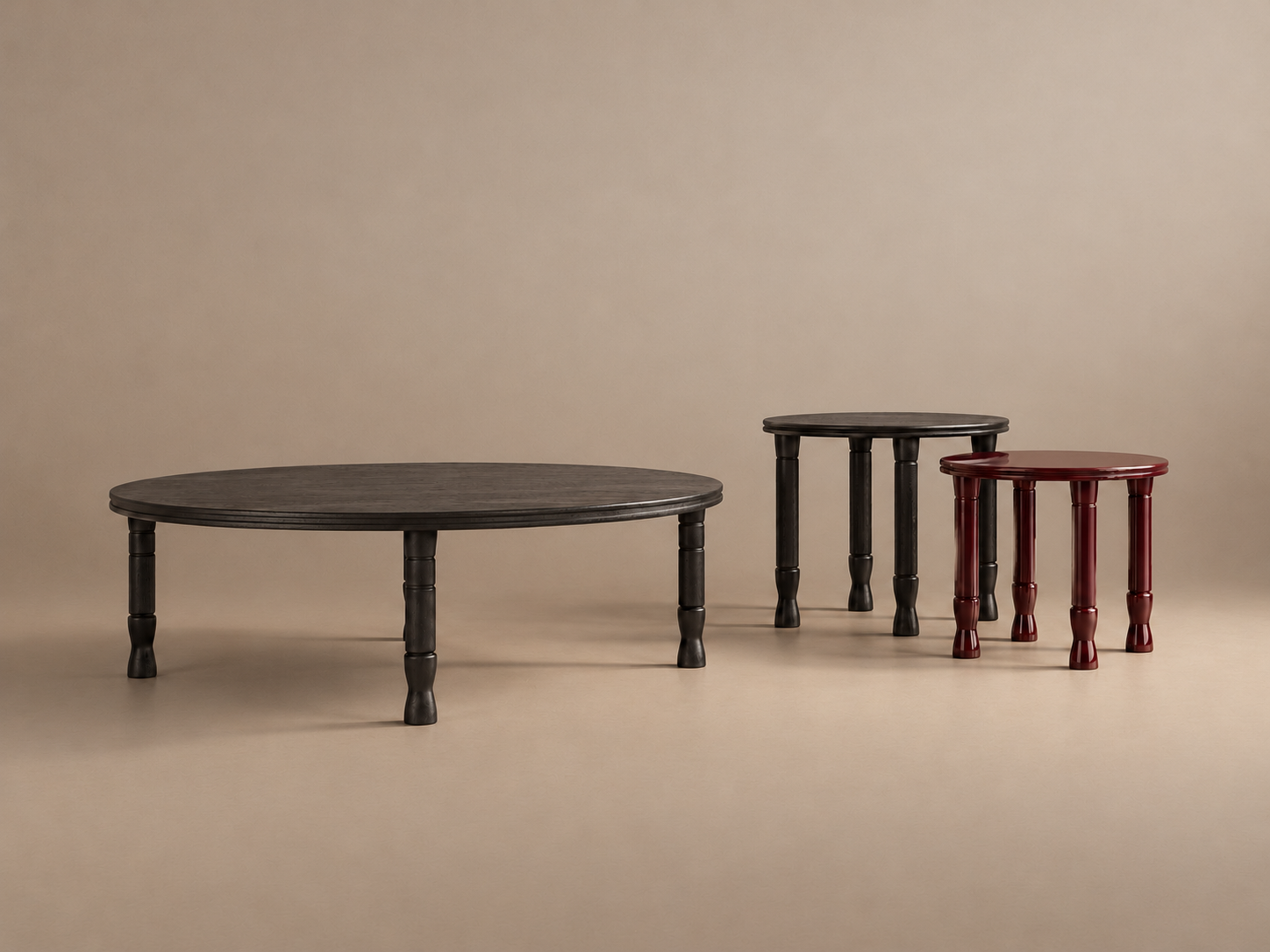
What feels right
Think of a chair you always choose. Perhaps it supports you in exactly the right place. Perhaps you like the enclosure of its back, or the ease with which you can shift your weight.
A table invites a different kind of relationship. Its height, the position of its legs and the shape of its edge all influence how comfortably you gather around it. There is the space for your knees, somewhere to rest your forearms, room for another person.
These details can appear small on a drawing. In daily life, they are the difference between something you accommodate and something that accommodates you.
Good form earns its place through use.
A room with feeling
Then there is what a piece brings emotionally.
A substantial table can give a room a sense of permanence. A curved cabinet can introduce softness to an otherwise angular space. A sculptural piece can create just enough tension to make everything around it more interesting.
There is pleasure in living with something that holds your attention. Something you chose because it felt like you, even if you could never quite explain the attraction.
A home takes on character through these choices. Over time, the objects become familiar: the edge your hand passes over, the chair pulled towards the afternoon light, the table where people stay long after dinner.
Their form becomes part of how you remember being there.
Form with a point of view
At Altone, we consider a piece from across the room and from the place where your hand meets it.
The silhouette needs conviction. The proportions need balance. The details need to make sense when you live with them.
Timber, lacquer and steel each bring a different quality to that conversation. Grain gives a surface movement. Colour gives a shape emphasis. Reflections allow a solid object to shift with its surroundings.
We design for that continuing relationship between a piece, a person and a space. For the initial attraction, and for the quieter satisfaction of living with it years later.
Because the things around us deserve consideration.
We live with their shape every day.